
Inside Talbot Property Tax Records
Maryland SDAT keeps the assessment record for each Talbot County parcel. Talbot County Finance keeps the bill. A sample county bill shows the levy period, parcel ID, property description, assessed value, amounts due, due-date or discount terms, and office contacts. Match the two records by account or parcel number.
| Field | What It Shows | Where |
|---|---|---|
| Current value | State assessment estimate | SDAT card |
| Assessment year | Value cycle and effective context | SDAT card |
| Principal residence | Tax-status field | SDAT card |
| Levy and amount due | County, state, and town charges | Talbot bill |
| Payment or arrears | Current collection status | Finance system |
Assessed value is what supports the tax. Market value is the state's own appraisal estimate. A deed's price belongs to the transfer record, may reflect a non-arm's-length event, and none of these figures stands in for a professional appraisal.
Look Up a Talbot Tax Bill
Begin at the SDAT Real Property Search. That lookup returns the Talbot account and parcel reference. Take those details to the Talbot MUNIS portal for the bill itself. County portals update their field labels over time, so keep the account and parcel number ready and follow the labels the page currently shows.
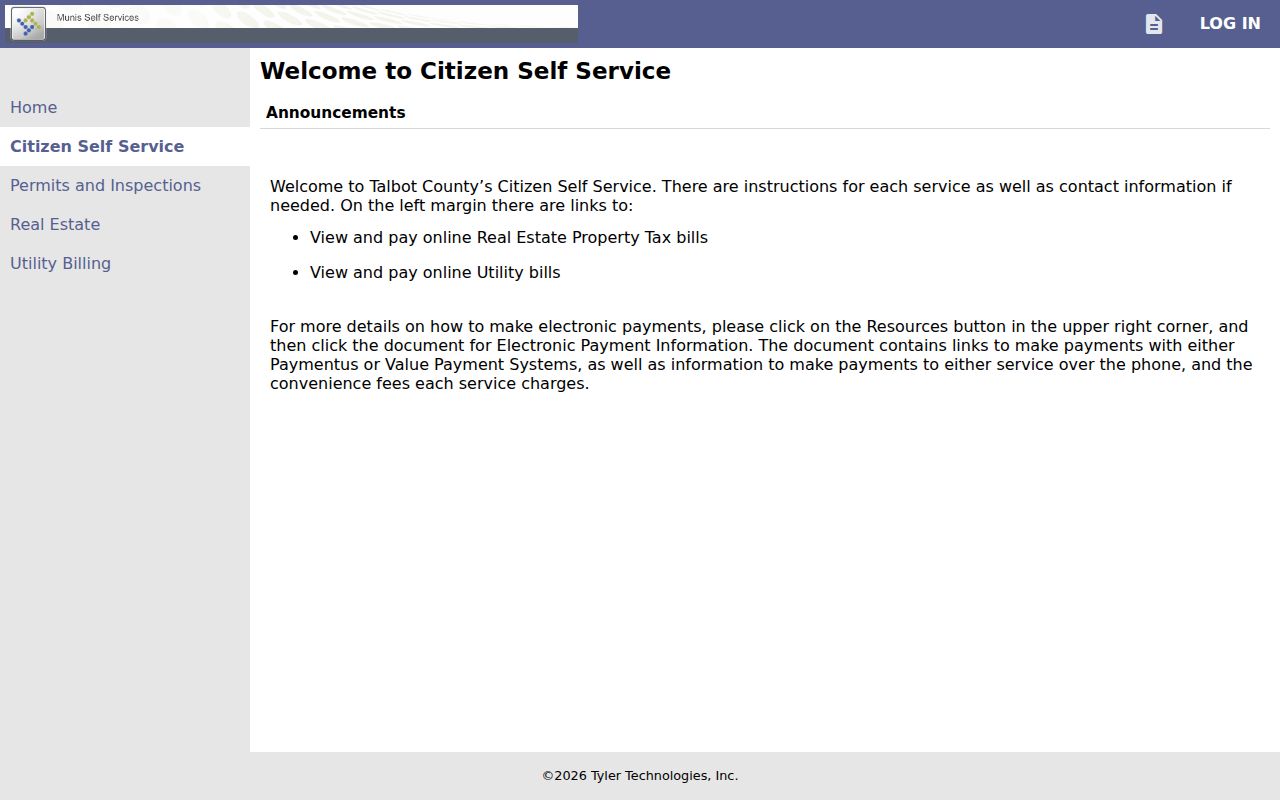
The county payment page lists current processors and fees.
- Find the SDAT card by address or account.
- Save the exact parcel and district keys.
- Open the Finance payment route and select the parcel.
- Read the levy period, charges, due dates, and status.
- Compare the bill's assessed value with the dated SDAT card.
- Assessed value
- The value placed on the assessment roll for tax use.
- Tax rate
- The charge per $100 of assessed value in Talbot's table.
- Abatement
- An authorized reduction distinct from ordinary assessment.
- Tax lien
- The statutory claim attached to unpaid property tax.
Six Talbot FY2026 Rate Contexts
One table makes the point plainly. The FY2026 rate table breaks Talbot County property tax into pieces rather than a single figure. Every rate applies per $100 of assessed value. Land outside town limits pays the county rate of $0.8032 plus a state rate of $0.1120. Incorporated parcels work differently, adding a municipal line to a different county rate.
| Area | County | Municipal | State |
|---|---|---|---|
| Unincorporated | $0.8032 | None listed | $0.1120 |
| Easton | $0.6702 | $0.520 | $0.1120 |
| Oxford | $0.6852 | $0.320 | $0.1120 |
| Queen Anne | $0.7431 | $0.180 | $0.1120 |
| St Michaels | $0.6762 | $0.470 | $0.1120 |
| Trappe | $0.7052 | $0.330 | $0.1120 |
The county rates include a $0.0106 education supplement. Check the fiscal year before using any rate, and confirm municipal jurisdiction from an official boundary rather than a postal label.
Talbot Reassessment Area Calendar
Talbot County splits into three SDAT reassessment areas. The cycle turns every three years. Area 1 became effective January 1, 2025, and Area 2 in 2023. Area 3 began in 2024. Their next reviews fall in 2028, 2026, and 2027 respectively, which explains why neighboring parcels can carry different assessment dates. Record the assessment date, property class, and characteristics first. A bill that changes may reflect a new assessment, a phased value, a rate change, a tax-credit decision, or a municipal line.
Talbot Tax Sale Stages
Taxes come due July 1 in Talbot County. They fall into arrears on October 1. Unpaid amounts accrue interest and penalty at 1 percent per month, and state, county, and municipal taxes all become liens from the due date. Each year Talbot sells the first lien and publishes the results. A tax-sale listing is not a deed. Delinquency, advertisement, sale, redemption, foreclosure of the right to redeem, and the eventual conveyance are separate events. Date every stage. Confirm each one through Finance, the court case, and the Land Records before claiming title changed hands.
Assessment and Bill Are Different
The classic mistake with Talbot County property tax records is treating the SDAT card as the bill. It is not. SDAT publishes property characteristics, assessment values, and tax-status fields. Finance handles the rest. Talbot County Finance applies the state, county, and municipal rates and manages the payment records. The two documents may share an assessed-value line. Their purposes differ, so compare the account, levy period, fiscal year, and assessment date; if figures still conflict, ask the source office to explain its own record rather than assuming one portal holds the newest value.
Appeal a Talbot Assessment
Maryland gives owners a real window to fight a number they think is wrong. SDAT's assessment appeal process typically allows 45 days from the date an assessment notice is issued. There is a second path for new owners. Buy between January 1 and June 30, and record the deed. A 60-day purchase appeal then opens up.
Strong evidence matters more than frustration. Bring the worksheet and an area sales listing. Add property facts and a plain statement of why the assessment misses the mark. The case moves through three stages. It starts with the Supervisor of Assessments, then the Property Tax Assessment Appeals Board. The final stop is the Maryland Tax Court. Talbot's Supervisor of Assessments sits at 29466 Pintail Drive, Suite 12, in Easton. The office is reachable at 410-819-5920. Hold onto the notice and control numbers for the online form.
Appeal window. Count from the notice or recorded purchase event that creates the right. The standard periods are deadlines, not suggested dates.
Verify Talbot Payment Requests
Talbot County warned residents in June 2025 about a fake permit-payment email. Fraudsters like that one often borrow real details. A parcel number in a message proves nothing. Before paying any Talbot County property tax bill, start at the official county domain and call the office yourself rather than trusting a link that arrives uninvited.
The Finance office lists 410-770-8020 and names its current payment processors along with mailing addresses, walk-in hours, and fees. Processor charges shift over time, so rely on the live payment page when you actually pay. Save your receipt and parcel reference, and keep them separate from anything an unsolicited message claims.
Read a Talbot Tax Bill Carefully
Start with the basics on the Talbot County bill. Check the levy period and the parcel number first. Lay the property description and assessed value beside the dated SDAT card, since the two should agree before anything else makes sense. From there, pull the state, county, and municipal charges apart, and copy any discount terms or due dates exactly as printed. A small bottom line is never evidence of an exemption, abatement, or credit on its own.
Payment status depends on the day you ask. A processor receipt, a Finance ledger entry, an arrears notice, and the tax-sale list each reflect a different point in the collection cycle. Recent payments need a posting date from Finance. For an older year, ask whether the public portal still carries it. If not, staff can retrieve the record directly.
A tax bill records an obligation, nothing more. It does not establish current title or market value. Ownership questions go to the latest recorded deed, and a disputed value belongs in the assessment appeal process. Keep those paths separate even when one parcel number ties them together.
Exemption, credit, and abatement are three different things. The 2025 County Council record on FY2026 abatements shows why precision matters. It shows 32 nonprofit parcels received $48,922.78 in total relief. That was one specific local action, not a blanket rule. Every nonprofit parcel does not get the same treatment. Confirm the enacted measure and then the individual bill.
Principal Residence on SDAT is a tax-status field either way. It does not prove who lives at an address. When a credit or cap matters, get the actual state or county determination. Get its effective year too. Guessing eligibility from an owner's name, mailing address, or apparent use invites error. The current record and the administering office should back any statement you make.