
Deed Types in Talbot County
A Talbot County deed does more than move title. Deed records name the parties, the recording date, the consideration, the legal description, and the references that tie instruments together. Labels help, but the operative text governs. Read each deed with its exhibits, exceptions, reservations, prior references, and acknowledgments instead of trusting the index line.
| Deed Type | What It Does | Common Use |
|---|---|---|
| Warranty deed | Conveys title with stated covenants | Arm's-length transfer |
| Quitclaim deed | Conveys whatever interest the grantor has | Interest cleanup or family transfer |
| Trustee deed | Conveys under trustee authority | Trust or foreclosure matter |
| Personal representative deed | Conveys through estate authority | Probate transfer |
| Corrective deed | Corrects a recorded detail | Name or description correction |
Related instruments work differently. A mortgage secures a debt, and its release records the discharge. An easement grants a defined use or access interest. A judgment or lien can burden land without transferring title at all. Search these by party, liber and folio, tax ID, or document reference. That reference is cited in the deed.
Follow Talbot Grantor-Grantee Entries
Maryland Land Records hosts the modern index and recorded images for Talbot County deeds. The November 2025 release requires a new account, email-based two-factor authentication, and limits each user to one device at a time. Last-name and corporation-name searching were merged in that release, so older screenshots may show field labels that no longer exist.
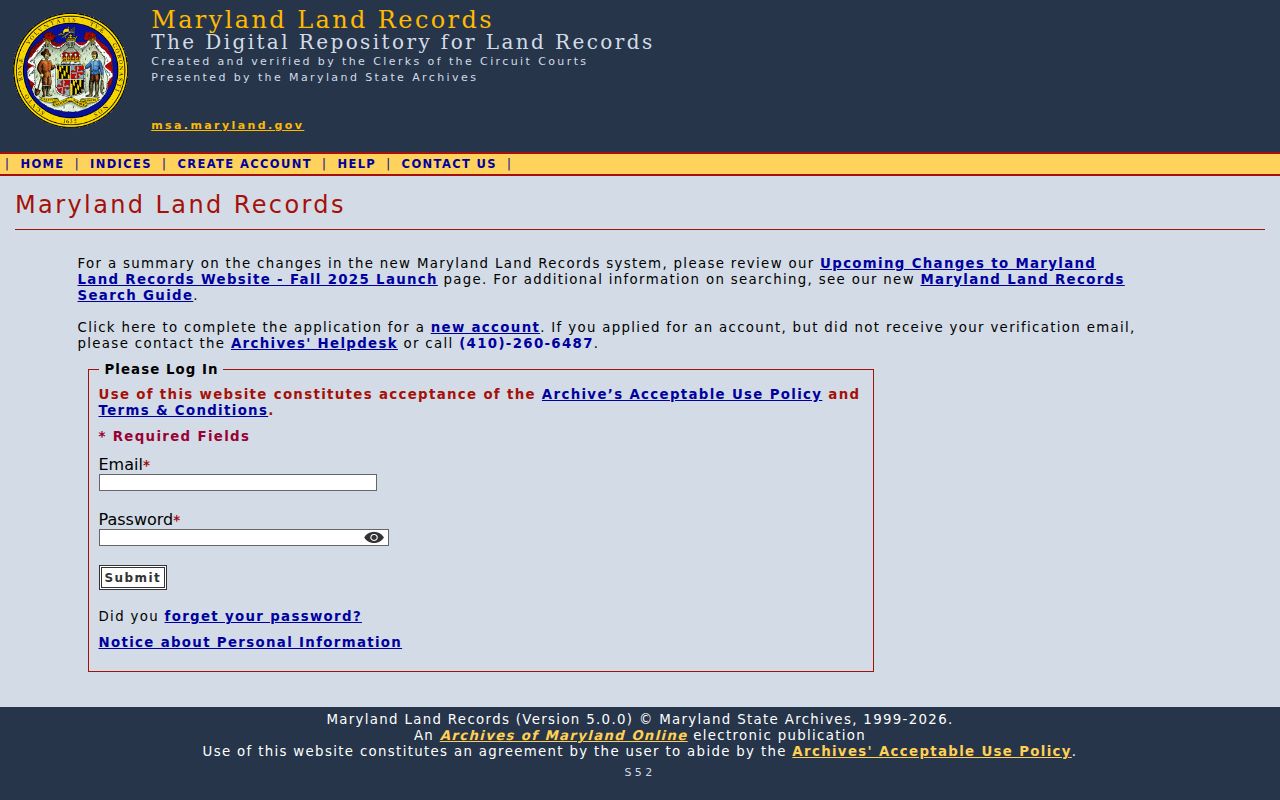
The login boundary is part of the search itself. A failed anonymous lookup is not evidence that a deed is missing.
- Start with the latest SDAT deed reference.
- Open the image and verify Talbot County, grantee, and legal description.
- Record the grantor, prior deed reference, date, and consideration.
- Search that grantor's earlier acquisition as a grantee.
- Repeat, moving to historic indexes when needed.
- Grantor
- The party conveying an interest.
- Grantee
- The party receiving an interest.
- Chain of title
- The ordered sequence of recorded conveyances for the same land.
- Liber and folio
- Maryland's book and page reference for a recorded document.
Read the Talbot Legal Description
A party match alone proves little. Compare the deed's lot, block, subdivision, tract, acreage, roads, streams, adjoining owners, and plat or prior-deed references before drawing conclusions. SDAT sometimes abbreviates the description. Waterfront and rural parcels may use cove, shoreline, farm, or metes-and-bounds language. These may have no clean street-address equivalent.
When descriptions conflict, never pick one silently. Check the latest deed, the cited plat, the account area, and any corrective instrument. If the location of a legal line is disputed, a survey may be required.
Talbot Plats Bridge Deed References
Plats.net for Talbot County accepts searches by plat or box number, right-of-way plat, book or cabinet, page, and date. Description, clerk initials, and series fields work too. Its collections span subdivisions, town surveys, roads, divisions, land commissions, judgments, wetlands, and historic certificates.
The C2400 index offers a shortcut. Its 1875 through 1945 portion runs alphabetically by tract, subdivision, or name. The 1959 through 1993 portion uses tract, subdivision, condominium, or owner references. Search the name from the deed. Then verify the book and page against the recorded instrument.
Talbot Deeds Reach Colonial Records
Maryland State Archives series carry Talbot land records back to 1662. Paper, electronic, and microfilm series each cover different date bands. Early searches may turn on tract names and patents. Watercourses, roads, and adjoining proprietors can matter too. Modern premises addresses were not always used.
The Talbot County Free Library Maryland Room adds maps and tax-list reels. Newspapers, census material, and vertical files are there as well. Treat those sources as leads that explain a property or neighborhood. Ownership proof stays in the deed chain.
Search Talbot Easements and Releases
Finding the purchase deed is only the start. Search the same parties and references for mortgages, releases, assignments, easements, restrictive covenants, and judgments. A mortgage and its release are separate instruments. Language making a deed "subject to" another document is a direct instruction to retrieve that record.
The Maryland judgment and lien index accepts person or company, name, exact match, county, and filing-date inputs. Its result is only an index lead. Review the underlying instrument before describing the nature or current status of any claim.
Corporate Names in Talbot Deeds
When a deed party is an entity, confirm its exact legal name in Maryland Business Express. Then use the corporation-name option in Land Records. A registered office, principal office, mailing address, and parcel premises can all differ. Tie the entity to the deed through the legal description, parcel reference, and recording date. Similar business names are not enough. Note any entity name change or assignment linking an older name to the current record.
Obtain a Talbot County Deed
Use the online image when one is available. Otherwise contact the Talbot County Circuit Court Clerk and Department of Land Records at 11 N Washington Street, Easton, 410-822-2611. The clerk lists weekday hours of 8:30 a.m. to 4:30 p.m. The county notice routes land-record questions to extension 4. Ask about current copy and certification requirements, since per-page fees change.
For very old books and indexes, use the Maryland State Archives Guide. It explains the search-room procedures. Record the source, book and page, instrument type, and parties for every item. A citation copied from SDAT should never be reported. The deed itself was not read.
Recorded, not guaranteed. The index reports accepted instruments. It does not resolve every defect, unrecorded interest, or question of marketable title.
Record a Reliable Talbot Deed Citation
A solid deed citation names Talbot County, the instrument type, the grantor and grantee, and the recording date. Include the liber and folio or instrument reference as well. Add the legal-description language that connects the deed to the parcel. When an image sits behind a login or only at the counter, call the citation an index lead. That label keeps your notes honest.
Be careful with dates. Settlement, execution, acknowledgment, recording, transfer, and the SDAT sale field can all differ. State plainly which one you are citing. Consideration can be nominal too. Treat it as a recorded figure, not a market appraisal of the property.
Corrections, rerecordings, and later deeds can change a name or a description. Keep the earlier citation in your notes instead of overwriting it. The sequence may be the very reason assessment records and deed records appear to disagree.
Estate and trust conveyances call for a full authority check. A personal representative may show up in Estate Search. The deed itself states the capacity in which that person signed. Trustee deeds arise in more than one setting as well. Read the recitals and any cited case, will, trust, or foreclosure reference. Do not guess from the label alone.
Road and subdivision history can split the evidence too. Plats.net keeps Talbot road papers, road records, town surveys, division plats, and subdivision plats in separate series. A current lot may trace back to a parent tract. It may then lead to a road dedication or a land-commission file. Save every parent reference you find, because early books carry no modern parcel number.