
Compare Talbot Property Value Types
The SDAT Real Property Search puts assessment, sales, and parcel fields in one place. Each figure answers a different question. An assessment is informational only, not a tax bill. Its market-land and market-improvement parts are not the consideration stated in a recorded deed.
| Value | What It Is | Where |
|---|---|---|
| Assessed value | Value carried for the property-tax system | SDAT assessment card |
| Market value estimate | State mass-appraisal estimate at the assessment date | SDAT land and improvement fields |
| Last sale price | Consideration reported for a transfer, subject to sale type | SDAT sales fields and recorded deed |
| Land and improvement | Components assigned to the site and built improvements | SDAT value detail |
Sometimes no record is wrong. The figures can reflect different dates, methods, or transaction types. A family transfer, estate deed, or corrective deed can carry consideration that says little about the open market. So read the sale type and deed context first.
Talbot Property Reassessment Calendar
Talbot County runs assessments on a staggered three-area cycle. SDAT's Talbot schedule sets the dates. Area 1 took effect January 1, 2025 and returns January 1, 2028. Area 2 was effective January 1, 2023 and comes back January 1, 2026. Area 3 took effect January 1, 2024 and returns January 1, 2027. Neighboring parcels can therefore carry values from different reassessment points. Check the effective date before comparing amounts. A newer figure can just mean a newer cycle.
Talbot Sales Comparison Evidence
The SDAT Area Sales Analysis lays out residential traits. It also explains its cost and sales-comparison methods, with useful fields such as site, property type, stories, quality, year built, area, and land or improvement components. Similarity needs testing. Never assume it. An assessment-to-sale ratio is assessed value divided by sale price. SDAT warns against reading the ratio as a price prediction. The market date and transfer type matter. So stick to arms-length transactions at relevant dates. Leave unusual transfers out of a casual price estimate.
Note: A comparable sale is evidence to analyze, not an appraisal by itself.
Find Talbot County Assessed Value
Search by parcel account, not owner name. SDAT asks for Talbot County plus a method like address, street, account ID, or map reference. The public portal skips owner-name, town, subdivision, neighborhood, and ZIP searches.
- Select Talbot County in SDAT and search by the premises address or account key.
- Confirm map, grid, parcel, legal description, and assessment year before copying a value.
- Record market land, market improvement, current value, and the effective assessment date.
- Read the sale date, price, and sale type, then verify the transfer against the deed reference.
- Use Area Sales Analysis for comparable context without calling the result an appraisal.
- Assessed value
- The value carried in the public assessment and tax system.
- Market value
- SDAT's mass-appraisal estimate as of the stated valuation date.
- Assessment ratio
- Assessed value divided by a sale or market measure for comparison.
- Consideration
- The price or value reported with a recorded transfer.
- Reassessment
- The scheduled review that places a new value on the roll.
Fields Behind Talbot Property Values
The SDAT real-property glossary defines current value, premises address, price, sale date, sale type, neighborhood, land area, use, year built, and related terms. Read the definitions first. "Current" means current within the roll. It is not the same as current in the open market.
| Field | Why It Matters |
|---|---|
| Assessment year | Dates the value carried on the account |
| Market land | Separates the site component from improvements |
| Market improvement | Shows the component assigned to buildings and improvements |
| Sale type | Helps judge whether a transfer is a useful market comparison |
| Deed reference | Connects the reported transfer to its recorded instrument |
SDAT's public-data layout also names grantor, transfer date, consideration, deed reference, liber, folio, mortgage, and sales-analysis fields. Tie every value back to its matching account.
Talbot Assessment Search Screen
The portal asks for a county and a search method. Open the live SDAT assessment search to see the current controls and any maintenance notice.
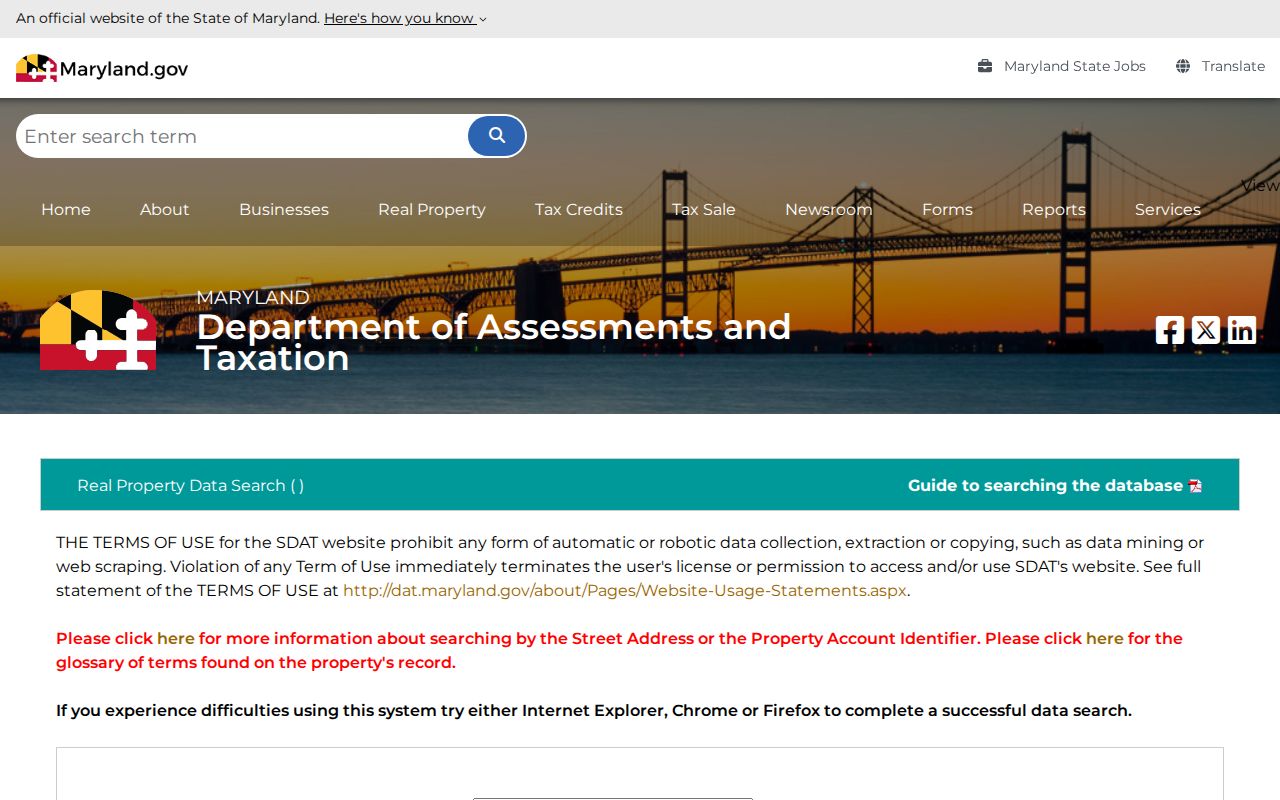
This SDAT screen is where the Talbot County property value lookup begins. The value itself appears in the matched account result. Date it whenever you cite it.
Talbot Sale Price Context
Test every SDAT sale price against the recorded deed in Maryland Land Records. The deed reference, recording date, parties, consideration, and sale type tell the real story. A contract alone does not move legal ownership. The recorded deed is the conveyance trail. Estate, family, corrective, and entity transfers are not open-market deals. Reported consideration can be a poor proxy for value. So phrase it as "SDAT lists" or "the deed reports," never as a claim about present worth.
Tax Rates Are Not Value
Talbot County publishes separate county and municipal rate contexts for unincorporated land, Easton, Oxford, Queen Anne, St Michaels, and Trappe. A rate turns an assessed value into a bill. It does not create market value. Nor does it change what a prior buyer paid. Exemptions, abatements, and principal-residence treatment can shift the taxable result. The market-value field may not budge. For bills, payment paths, and appeal steps, see the Talbot County property tax records page.
When Talbot Property Needs Appraisal
Public data supports a first comparison, not a final opinion. A Maryland-licensed appraiser can inspect the property and pick suitable comparables. They can adjust for condition and features and set an effective valuation date. Waterfront influence, easements, condition, and recent improvements may not show on the assessment card. Keep the records trail anyway. The parcel ID, legal description, assessment history, deed, and sale type give the appraiser a sound starting set. Relevant plats help too. They also expose conflicts needing closer review.
Limits of Talbot Assessed Value
A Talbot County assessed value comes from mass appraisal built for taxation. It is not a site-specific opinion for a purchase, an estate, or a boundary-linked valuation. Markets move. Properties change too. Conditions may have shifted since the assessment date. The property itself may no longer match the characteristics SDAT gathered.
Value is not a price promise. An assessed value is for taxation and is neither a current sale price nor a licensed appraisal.
Document Talbot Property Value
A useful value note names the parcel, the field, the amount, the effective date, and the source. Label every figure clearly. Market land, market improvement, and total value each carry distinct meanings. So do the assessment year, sale price, sale type, and deed reference. A number without its label can mislead.
When two records conflict, keep both. A deed may have been recorded after SDAT's last update, or a sale may not have been an arms-length market transfer, so state what each official record lists rather than calling either one false.
Talbot Assessment Help
The local Supervisor of Assessments sits at 29466 Pintail Drive, Suite 12, in Easton. Call 410-819-5920. Staff there can explain the assessment record and the reassessment area. The office does not issue the county tax bill. Nor does it provide a private appraisal.
Billing questions belong with Talbot County Finance, and questions about a recorded sale instrument go to the Circuit Court land-record system, which keeps an assessed value from being confused with taxes due or legal title.
Compare Talbot Property Sales
Start every comparison with a consistent set of physical and record traits. Property type, land area, building area, stories, quality, year built, use, neighborhood, and assessment date all shape a sale's usefulness. Waterfront setting, flood or critical-area context, easements, and road access may need separate review.
Then inspect the transaction itself. The sale date sets the market point. Sale type helps separate an arms-length deal from a family, estate, corrective, or entity transfer. Verify consideration through the deed reference. A high or low figure without that context should not drive a Talbot County property value estimate. Seek more context first.
Use more than one relevant sale. Explain why each was chosen. Treat SDAT's Area Sales Analysis as support rather than a forecast. Market date matters, and an assessment-to-sale ratio is a rough tool.
Why Talbot Values Change
Reassessment can change the value carried on the roll. So can new construction, demolition, shifting property characteristics, market evidence, a parcel split, or corrected data. The assessment year and finality date explain when the figure took effect.
A new deed does not force an immediate update. Transfer records and assessment rolls move on separate tracks. Compare the recording date, transfer date, and the card's assessment date before calling any value current. If the parcel was split or combined, confirm the account is still active and covers the same land.
Principal-residence status, exemptions, caps, and abatements change tax treatment. They do not state open-market worth. Talbot County's September 2025 report of abatements for nonprofits shows why. Tax treatment cannot be inferred from property use alone.
Match Talbot Value to Land
Confirm the parcel first. Before comparing figures, check that every record describes the same land. A premises address can differ from a mailing address. The number used for assessment can differ. Use map/grid/parcel, account ID, legal description, and deed reference as the crosswalk.
Postal city and ZIP do not prove municipal jurisdiction. Talbot publishes distinct county and municipal tax contexts, so the mailing label cannot tell you which bill and rate lines apply. That distinction does not alter the meaning of SDAT's market-value field. Map the town boundary instead.
A modern address can hide an older tract name. Follow the deed and plat references, because the land itself must match before a prior sale can serve as comparison evidence.
Resolve Talbot Value Gaps
Some portals show only a login shell. Others may fail to render a stable result. In that case, go to the office that holds the record. For assessment fields, contact the Supervisor of Assessments with the account ID. For a tax document, ask Talbot Finance. For consideration and conveyance terms, retrieve the recorded deed.
A narrow Maryland Public Information Act request can seek an existing county record by parcel, type, and date range, though it cannot force an agency to create a market analysis or appraisal. If a defensible present value is needed, hire a qualified appraiser and provide the verified parcel record.